
Essential Project Manager
540-929-1673
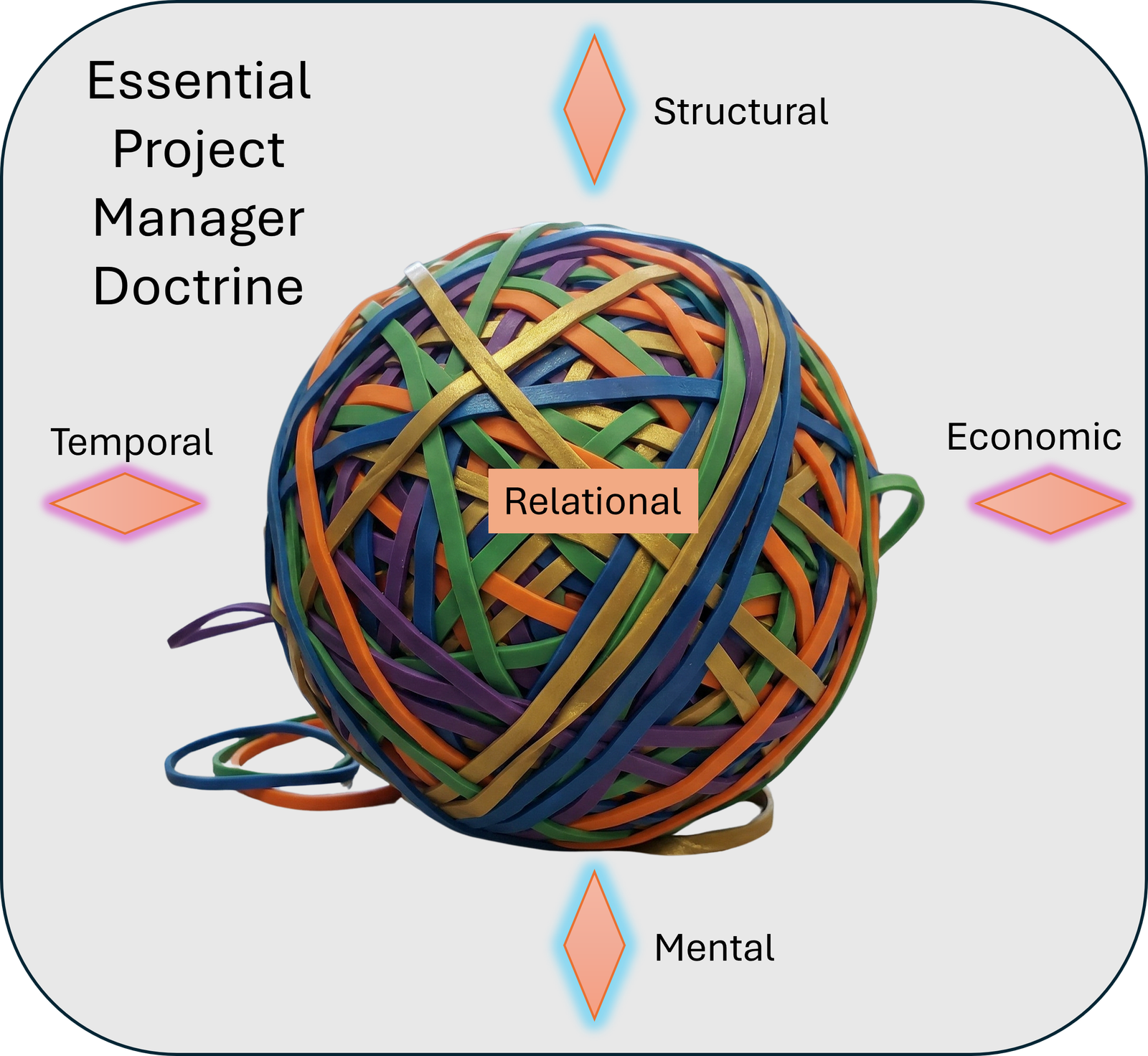
The EPM Doctrine — Five Disciplines
The Essential Project Manager Doctrine: to help you find your North star in the chaos of Projects
- Structural: The architecture of intention — scope, sequencing, accountability.
- Mental: Stoic stability and the mastery of perception under pressure.
- Economic: Follow the money. See what is actually driving behavior.
- Temporal: The flow of value through time — deliver when it matters most.
- Relational: Build trust that makes structure, insight, and urgency consequential.
“Not a set of rules — a way of seeing, and a way of being with others while you see it.” — Allen Evitts
The Essential Project Manager Doctrine
A Complete Operating Philosophy
By Allen Evitts
Project management is, at its core, a discipline of judgment under pressure. Every project is a living thing — it breathes through deadlines, bleeds through budgets, and either thrives or collapses under the weight of decisions made in imperfect conditions. The Essential Project Manager Doctrine does not offer a checklist or a methodology. It offers something more durable: a philosophy. Five disciplines — Structural, Mental, Economic, Temporal, and Relational — form the interlocking pillars of a complete operating framework for anyone who moves work through the world.
The first four disciplines sharpen how the project manager sees. The fifth determines whether anyone follows.
I. Structural Discipline: How Work Is Organized and Moved
Structure is not bureaucracy. It is the architecture of intention. Without it, effort scatters — people work hard in directions that cancel each other out, deliverables drift, and accountability dissolves into ambiguity. The first discipline of the essential project manager is the ability to impose meaningful order on complexity without crushing the energy of those working within it.
Structural discipline begins with clarity of scope. Before a project can move, it must be defined — not in exhaustive contractual language, but in terms that every stakeholder can hold in their mind simultaneously. What are we building? What are we not building? What does done look like? These are not administrative questions; they are the load-bearing walls of the entire endeavor.
From scope flows structure: the breakdown of work into manageable, assignable units; the sequencing of dependencies; the identification of critical paths. A structurally disciplined project manager does not merely track tasks — they design the system through which tasks flow. They understand that how work is organized determines how fast it moves, where it stalls, and who owns each outcome. Structure, done well, is invisible. Done poorly, it is the first thing everyone blames.
II. Mental Discipline: Stoic Stability and Perception
No project survives contact with reality unchanged. Vendors fail. Estimates prove wrong. Sponsors change priorities. Team members leave. Crises arrive not on schedule but at the worst possible moment. The project manager who responds to this turbulence with panic, denial, or blame becomes part of the problem. The one who meets it with Stoic stability becomes the steady center around which the team can reorganize.
Mental discipline is not the suppression of emotion — it is the mastery of perception. The Stoics understood that events do not disturb us; our judgments about events disturb us. A project manager who has internalized this does not see a delayed deliverable as a catastrophe. They see it as a problem with a solution — or, if unsolvable, as a constraint to be communicated and adapted to. They distinguish clearly between what is within their control and what is not, and they spend their energy accordingly.
There is also a perceptual skill at the heart of this discipline: the ability to see a project as it actually is, not as it was planned to be. Wishful thinking is the enemy of good project management. The mentally disciplined manager reads the signals in front of them — slipping velocity, growing technical debt, a team that has gone quiet — and names what they see, even when it is inconvenient. Clarity is an act of courage.
III. Economic Discipline: Follow the Money
To follow the money is not to fixate on budgets or burn rates. It is to ask a more penetrating question: how are the people around this project actually being rewarded? Not how they are supposed to be rewarded — but how incentives are truly operating in practice. This is the economic discipline of the essential project manager, and it may be the most underappreciated analytical skill in the profession.
“Money” in this sense is not limited to compensation. It encompasses every form of reward that shapes human behavior: recognition, autonomy, status, safety, professional identity, and freedom. People do not act on stated goals alone — they act within the incentive environments they actually inhabit. When a project stalls for no apparent reason, when scope quietly expands, when urgency fades despite clear deadlines, the economic discipline prompts the right diagnostic questions. What behavior is being rewarded here? Whose interests are served by the current trajectory? Where are the incentives misaligned?
What often looks like resistance is, in fact, rational behavior within a layered incentive environment. A team that seems disengaged may be responding to a reward system that does not value what the project demands. A stakeholder who keeps widening the scope may be doing so because delivery — not completion — is what earns them recognition. The project manager who cannot see these forces will exhaust themselves pushing against invisible walls. The one who can see them gains leverage.
Economic discipline is therefore an act of clarity, not cynicism. It does not assume that people are mercenary or that organizations are corrupt. It assumes that people are human — that they respond to the conditions they are placed in, and that those conditions can be shaped. By making incentive structures visible, the project manager moves from reacting to execution problems to deliberately designing the environment in which progress becomes the path of least resistance.
Following the money is how you understand why the work is actually moving — or not moving — and what it will take to change that.
IV. Temporal Discipline: The Flow of Value Through Time
Time is the only resource that cannot be recovered. A project manager who is cavalier about time — who allows scope creep to compress schedules, who lets meetings run long, who defers hard decisions — is eroding the one asset that is truly irreplaceable. Temporal discipline is the conscious, continuous practice of treating time as the finite and precious thing it is.
But temporal discipline is not simply about speed or urgency. It is about the flow of value through time — understanding when each piece of a project should land in order to produce maximum benefit. Sometimes the right move is to deliver an incomplete but usable product early and iterate. Sometimes it is to wait until the conditions for success are in place. The temporally disciplined manager reads the rhythm of the project and calibrates the pace of delivery to match the appetite and readiness of those who will receive it.
Deadlines are not arbitrary cruelties — they are the mechanism by which value is made real. A project that delivers perpetually just around the corner delivers nothing. Temporal discipline is the commitment to turning intentions into outcomes at the moment when those outcomes can actually be used.
V. Relational Discipline: Bringing Others Along
The first four disciplines are internal. They sharpen the project manager’s ability to see clearly, think steadily, read incentives accurately, and act at the right moment. But a project is not a solo performance. It is a collective act — executed by people with different goals, different fears, different relationships to the work, and different reasons to care. Relational discipline is the capacity to build the trust and shared understanding without which no amount of structural clarity, mental stability, economic insight, or temporal precision can move an organization to deliver something it has never delivered before.
At its simplest, relational discipline is the practice of making people feel that the project is something happening with them, not to them. This distinction sounds soft. It is not. Projects that lack it suffer a particular and recurring pathology: technically competent execution that generates no ownership, no momentum, and no defenders when the organization’s attention shifts elsewhere. The work gets done, on paper. But no one fights for it. No one adapts when something goes wrong. No one carries the outcome forward after the project manager leaves the room.
Relational discipline operates at three levels. The first is individual trust — the quiet, accumulated credibility that comes from doing what you say, saying what you see, and treating people’s concerns as real rather than inconvenient. Trust of this kind cannot be manufactured on demand. It is built in small moments and destroyed in large ones, and the project manager who neglects it will find that their most carefully reasoned decisions are met with skepticism rather than confidence.
The second level is coalition. Every consequential project exists inside a political environment. There are people whose support is essential and whose opposition is fatal — and these are not always the people with the most formal authority. The relationally disciplined project manager maps this terrain as carefully as they map the work breakdown structure. They identify who needs to be brought in early, whose concerns must be addressed before momentum can build, and whose voice in the right room at the right moment can unblock what no amount of process could move.
The third level is shared narrative. People do not commit to projects — they commit to stories about what the project means, where it is going, and why it matters to them personally. The project manager who can articulate that story clearly, honestly, and in terms that connect to what different stakeholders actually value is doing something that no Gantt chart can do. They are creating the conditions for voluntary effort — the discretionary energy that separates a team that meets its obligations from one that finds a way through.
Relational discipline does not mean being liked. It means being trusted, being legible, and being worth following — even when the news is hard, the path is uncertain, and the finish line keeps moving. It is the discipline that makes all the others consequential.
A Complete Operating Philosophy
The five disciplines of the Essential Project Manager Doctrine are not independent skills to be checked off a list. They are interdependent, and their interdependence is not symmetrical — it is sequential in the deepest sense. Structural discipline gives the project its bones. Mental discipline gives the project manager their footing. Economic discipline gives them sight into what is really driving behavior. Temporal discipline ensures that insight becomes delivery. And relational discipline ensures that delivery becomes something the organization actually owns, uses, and builds upon.
Each discipline also corrects for the excesses of the others. Structure without relationships becomes rigid and brittle — a system no one believes in. Relationships without structure become warm and directionless — a team that trusts each other but cannot land. Mental stability without relational attunement becomes cold detachment. Economic clarity without trust becomes surveillance. Temporal urgency without coalition becomes pressure that burns people out rather than bringing them together.
Together, the five disciplines constitute more than a management toolkit. They constitute a worldview — a way of engaging with complexity, uncertainty, constraint, and human ambition that is simultaneously rigorous and adaptive, analytical and deeply human. The essential project manager is not the one who follows the process most faithfully. They are the one who sees the whole picture: the work, the people, the incentives, the time, and the relationships that make all of it possible.
That is the doctrine. Not a set of rules, but a way of seeing — and a way of being with others while you see it.

I’m Allen evitts
Essential Project Manager
Contact us today: 540-929-1673 – allenevitts@essentialprojectmanager.com